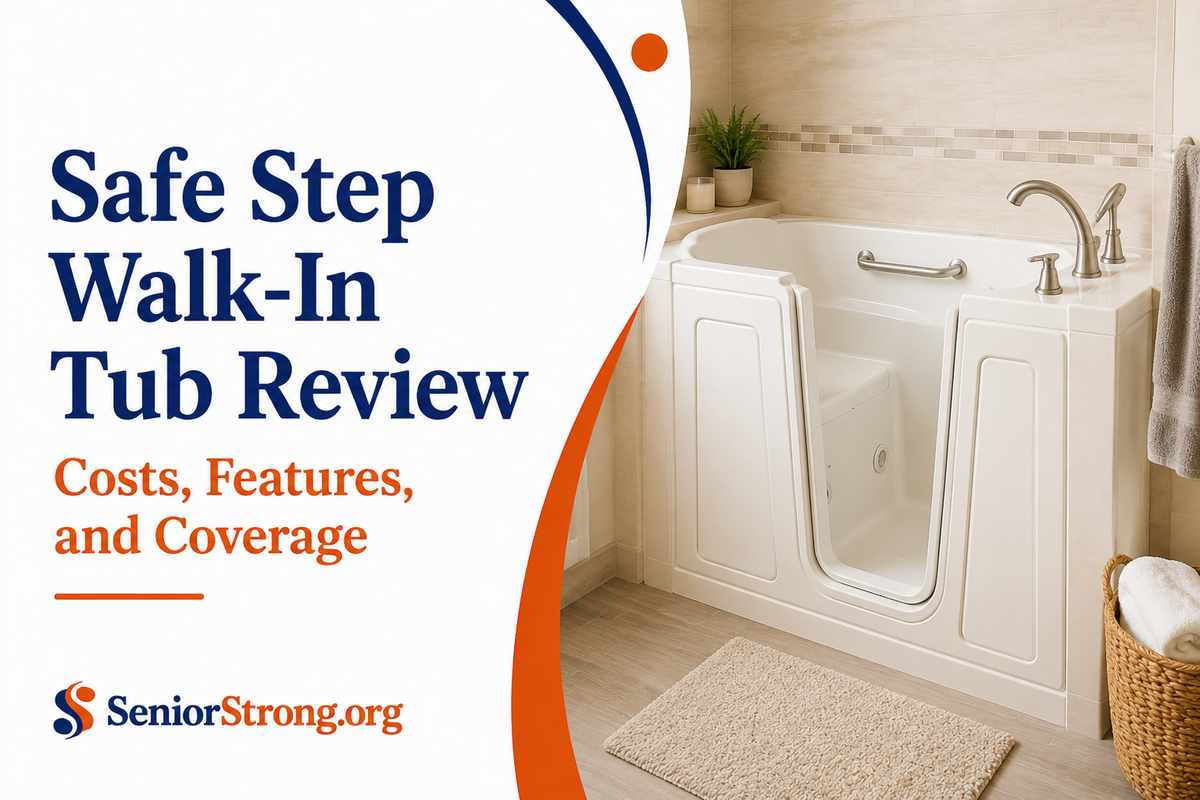
A Safe Step walk-in tubA bathtub designed with a door to avoid the need to step over the tub edge, reducing the risk of fal... is a custom-built accessible bathtub with a low step-in threshold, a watertight door, a built-in seat, and therapy jets, priced at roughly $8,000 to $12,000 installed in 2026. It is built for seniors who want to keep bathing on their own, and for families worried about a fall in the bathroom. That worry is well-founded. The CDC reports that 1 in 4 adults age 65 and older falls each year, and about 37% of those falls cause an injury that needs treatment.
This review covers what a Safe Step tub actually costs, its safety and therapy features, its warranty, honest customer feedback, and what MedicareA federal health insurance program for people who are 65 or older, certain younger people with disab..., MedicaidA state and federal program that provides health coverage to eligible low-income adults, children, p..., and VA benefits willA legal document that states how a person's property should be managed and distributed after death. and will not pay.
A Safe Step walk-in tub is a bathtub with a side door and a low entry threshold that lets a person step in without climbing over a high wall. The user opens the door, sits on a built-in seat, seals the door, and then fills the tub. Safe Step, founded in 2008 and based in Nashville, Tennessee, builds each unit to fit the customer's bathroom.
The design solves a specific problem. A standard bathtub wall sits 14 to 18 inches off the floor, and lifting a leg over that wall on a wet surface is one of the most dangerous moments in a senior's day. A Safe Step tub replaces that wall with a threshold a few inches high, so you never step over standing water. You enter while the tub is empty and drain it before you exit.
A few terms help before you compare quotes. Hydrotherapy jets push pressurized water against muscles and joints. Air therapy (Safe Step brands its version MicroSoothe) releases streams of warm bubbles. Durable medical equipment, or DME, is Medicare's category for prescribed in-home medical gear, and walk-in tubs fall outside it, which matters for coverage later in this review.
The people who benefit most are seniors with arthritis, balance problems, limited mobility, or a recent fall, plus the adult children helping them decide. The stakes are real: the National Safety Council reports that 43,020 people age 65 and older died from preventable falls in 2024, and more than 3.85 million were treated in emergency departments for fall injuries in 2023. A walk-in tub is one modification that removes a known hazard from daily life.
A Safe Step walk-in tub costs about $8,000 to $12,000 installed in 2026. The tub unit alone ranges from $3,000 to $15,000, depending on features, and Safe Step folds bathroom modification, plumbing, and electrical work into one quoted price after a free in-home assessment.
Safe Step does not publish a fixed price list. Every job is quoted after a home visit, and the company backs its quotes with a Lowest Price Guarantee. The upside is that the number you get includes installation, so there are fewer surprise charges. The downside is that you cannot compare prices online before a salesperson visits, a point reviewers often raise.
Feature load drives most of the price. A basic soaker with a door and seat sits at the low end. Add hydrotherapy jets, air therapy, a heated seat, and chromotherapy, and you move toward the top. Installation adds its own variables: repositioning drain and supply lines, adding a dedicated electrical circuit for jets and heated features, removing the old tub, and sometimes upgrading a water heater, since a walk-in tub holds 50 to 80 gallons.
| Cost component | Typical 2026 range |
|---|---|
| Basic soaker walk-in tub (unit only) | $3,000 to $5,000 |
| Hydrotherapy walk-in tub (unit only) | $5,000 to $10,000 |
| Air and hydrotherapy combo (unit only) | $8,000 to $15,000 |
| Professional installation | $2,500 to $8,000 |
| Safe Step all-in quote (unit plus install) | $8,000 to $12,000 |
Ranges reflect 2026 figures from the National Council on Aging and Safe Step's own pricing guidance. Your final number depends on your bathroom, your region, and the features you choose.
Safe Step includes safety and therapy features as standard that many competitors sell as paid upgrades. The safety set reduces fall risk during entry, seating, and exit. The therapy set targets arthritis, poor circulation, and joint pain. Here are the features that show up on most Safe Step builds.
Two credentials back these features. Safe Step holds the Arthritis Foundation Ease of Use Commendation, awarded to products that are easier to use for people with arthritis, and its tubs are ADA compliant. Every unit is made in the United States and carries a lifetime warranty. A quick-drain system empties the tub in about 60 to 90 seconds, so you are not sitting in cooling water for long.
No. Original Medicare, meaning Parts A and B, does not cover a Safe Step walk-in tub or any walk-in tub. Medicare classifies these tubs as home modifications or convenience items rather than durable medical equipment, so they do not qualify for coverage even with a doctor's note in most cases.
A walk-in tub fails Medicare's DME test because a person who is not sick or injured can also use it. According to the National Council on Aging, Medicare reserves DME coverage for items like wheelchairs, walkers, and CPAP machines. Original Medicare also generally does not cover bathtub seats, shower chairs, grab bars, nonslip flooring, or raised toilet seatsToilet accessories designed to increase the height of toilet seats, making it easier for seniors to ... because CMS treats them as convenience or hygienic items. A bedside commode may be covered under Part B only when the beneficiaryA person who derives advantage from something, especially a trust, will, or life insurance policy. meets Medicare’s medical-necessity requirements.
Medicare Advantage, or Part C, is the one exception worth checking. Some Advantage plans now offer home safety modification benefits that may cover part of a walk-in tub. Coverage varies widely by plan and usually requires prior authorization and documentation of medical need. Part D, which covers prescription drugs, never applies to a walk-in tub.
If Original Medicare will not pay, six other routes can reduce the cost of a Safe Step walk-in tub. Most require documentation of medical need, and several are limited to specific groups such as veterans or Medicaid enrollees.
Safe Step, Kohler, and American Standard are three of the most recognized walk-in tub brands in 2026. Safe Step leans toward custom builds with therapy features included. Kohler offers the lowest step-in and the most design choices. American Standard sits between them with a wide range of models. The table below summarizes how reviewers describe each brand.
| Factor | Safe Step | Kohler | American Standard |
|---|---|---|---|
| Step-in height | About 4 inches | About 3 inches (lowest) | About 4 inches |
| Pricing | Custom quote only | Custom quote only | Custom quote only |
| Therapy features | Included as standard | Available as options | Available as options |
| Customization | Custom-built to fit | Most design choices | Wide model range |
| Warranty | Lifetime | Limited lifetime | Lifetime |
| Often best for | Arthritis, custom fit | Low entry, design | Model variety |
Reviewers at SeniorLiving.org describe Safe Step as the more affordable option with fewer model choices, while American Standard offers more features, and Kohler leads on the lowest step-in height. If a tub-and-shower setup fits your bathroom better, compare these against walk-in tub and shower combos before you decide.
Safe Step earns an A+ rating from the Better Business Bureau and averages above 4 out of 5 stars across independent review platforms in 2026, but the feedback is mixed. Praise centers on safety and pain relief. Complaints center on installation timelines and occasional leaks.
On the positive side, buyers point to easy entry, the hydrotherapy jets, and real relief from conditions like arthritis and rheumatoid arthritis. Many describe getting back the ability to bathe alone, which matters as much for dignity as for safety. A BestGuide expert panel scored Safe Step 4.0 out of 5, praising the low step-in and the quick-drain system.
On the negative side, the most common complaint reviewers report is leaks that appear soon after installation, followed by long waits for installation and frustration with post-install service fees. The lack of upfront pricing also draws criticism. None of these are unique to Safe Step in the walk-in tub industry, but they are worth raising with a salesperson before you sign. Ask for the installation timeline and the exact service and repair terms in writing.
A Safe Step walk-in tub is a solid choice for seniors who want a safer bath with therapy features built in, and its Arthritis Foundation commendation and lifetime warranty back that up. As of 2026, plan for a total around $8,000 to $12,000, know that Original Medicare will not help, and check Medicare Advantage, Medicaid, and VA grants to bring the cost down. Get the installation timeline and service terms in writing, and compare at least two brands before you commit.
To weigh every option side by side, read our roundup of the safest bathtubs for seniors next.
No. Original Medicare (Parts A and B) does not cover walk-in tubs because it classifies them as home modifications, not durable medical equipment. A Medicare Advantage planA type of Medicare health plan offered by a private company that contracts with Medicare to provide ... may cover part of the cost as a home safety benefit, but this varies by plan and usually needs prior authorization and a doctor's letter of medical necessity.
A Safe Step walk-in tub typically costs $8,000 to $12,000 installed in 2026, with the tub unit alone ranging from $3,000 to $15,000. Safe Step quotes each job after a free in-home assessment and includes installation in the price, so the number you receive already covers plumbing, electrical, and bathroom modifications.
Sometimes. The VA HISA grant provides up to $6,800 lifetime for eligible veterans, but it excludes jetted tubs, so only a non-jetted walk-in tub qualifies. Veterans with qualifying severe service-connected disabilities may access SAH or SHA grants that cover far more, up to $126,526 for the fiscal year 2026.
For seniors with arthritis, balance problems, or a history of falls, a Safe Step tub can be worth the cost because it removes a daily fall hazard and adds therapy features. It is less compelling for people on a tight budget or with a small bathroom, where a simpler tub or a roll-in shower may deliver similar safety for less.
Safe Step backs its walk-in tubs with a lifetime warranty covering the tub itself. As with any warranty, coverage details depend on the terms in your contract, so confirm what the warranty includes, what it excludes, and how service calls and repair fees are handled before you buy.